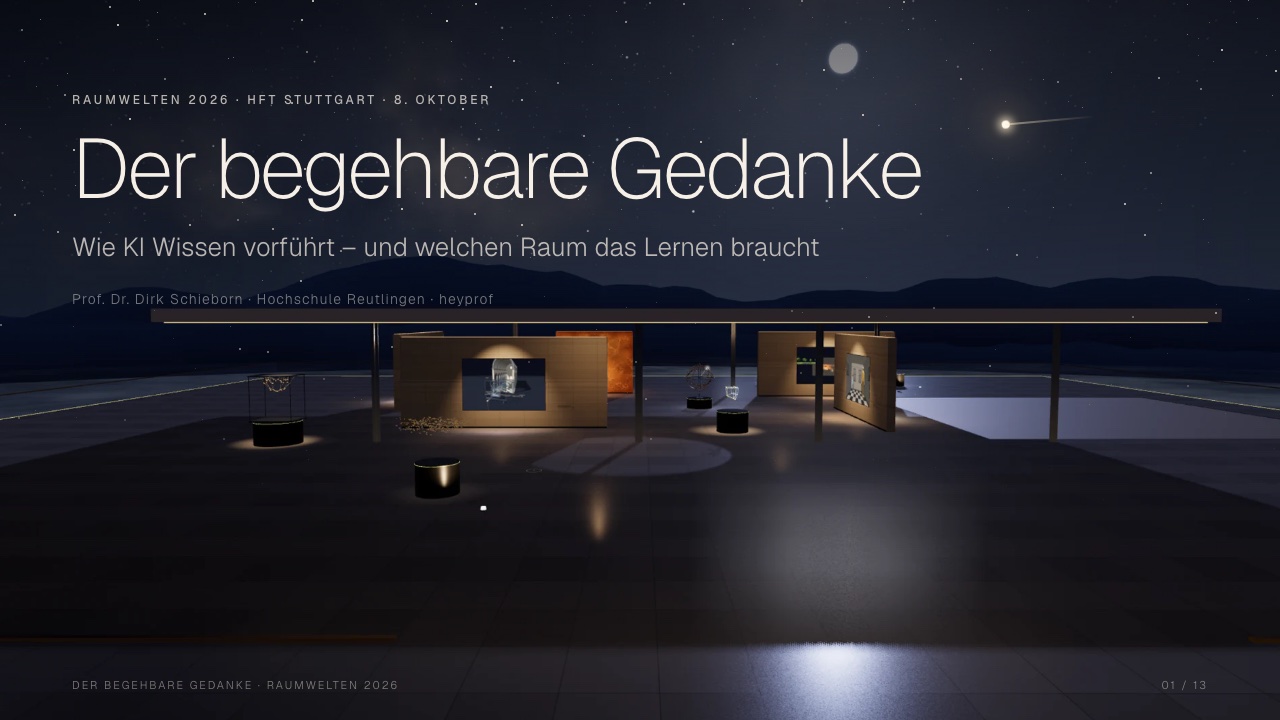
The Walkable Thought – Raumwelten 2026
Talk at Raumwelten 2026 at HFT Stuttgart: how AI demonstrates knowledge – and what kind of space learning needs. With a live demo in the walkable pavilion “Knowledge as Space”.
Event: Raumwelten 2026 – Platform for Scenography, Architecture and Media, motto “The Space is the Place”
Venue: Stuttgart University of Applied Sciences (HFT Stuttgart), Building 8, Room 043
Date: October 8, 2026, 1:45–2:30 pm
Raumwelten, based in Ludwigsburg from 2012 to 2022, relaunched in 2026 at HFT Stuttgart: two days of conference, workshops and cultural programme around the question of why physical spaces become more important in the age of AI. Organised by HFT Stuttgart (Faculty of Architecture and Design, Prof. Thomas Hundt) with the Stuttgart Region Economic Development Corporation and the Art Directors Club, curated by Prof. Ulrich Wegenast.
In the programme slot “Knowledge as Space”, Prof. Dr. Dirk Schieborn spoke on The Walkable Thought – How AI demonstrates knowledge and what kind of space learning needs (original title: “Der begehbare Gedanke”). The talk took place inside the tool it was about: slides and live demo ran in heyprof.
The Demonstration: Teaching Leaves Language Behind
Large language models are surprisingly good teachers, but in language. In heyprof, the model answers a question with stage directions for an interactive VisuApp: camera, pointer, parameters, speech bubbles. Like a puppeteer with the stage and figures ready, the AI stages the answer for this one question. That is explain mode. Background: Bloom’s 2 Sigma Problem (1984) and a recent physics study in which a pedagogically guided AI tutor produced more learning in less time than active in-class learning (Kestin et al., 2025).
The Space: An Ally of Knowledge
The second thread: what kind of space people need for what they are shown to stick. Well-established findings include dual coding, the multimedia and coherence principles, cognitive load, and restored attention through openness and calm. Yet more immersion does not automatically mean more learning. The method of loci shows how spatially memory works; memory palaces also work in virtual environments. The design principle that follows: the space holds back so the content can take effect.
The Design Study: Knowledge as Space
The talk ended with a live demo: a walkable pavilion on a table mountain at night, described by Dirk Schieborn and built with AI. VisuApps run inside the walls, calm 3D exhibits such as a gyroid, an armillary sphere and the Lorenz attractor stand on plinths, and the companion Nova guides visitors through the space and explains. Three testable hypotheses conclude the study: apps in fixed places are remembered better than in a list, guided demonstration and free exploration work better together than either alone, and a calm environment measurably lowers perceived load.
Step inside: heyprof.app/wissen-als-raum →