Crazy Claude Code
How I built my personal website in three hours – together with an AI that can do just about anything
Dear reader, this is me, Dirk Schieborn, writing. This sentence comes from my own fingers; any typo (hopefully absent) is entirely my own fault. Everything after this paragraph was not written by me but by Claude Code. This entire website is the result of an experiment: my first serious attempt at working with this incredibly capable AI tool. I installed it yesterday (February 18, 2026). Two or three small, promising tests, and then we were off. I wanted to build a personal website (this website) that brings together my work as a mathematician, musician, and AI enthusiast. Having suffered through WordPress for years and grown tired of its sluggishness and the maintenance burden of its plugins, I wanted something super lightweight — fast to load, no unnecessary bells and whistles. What did I do? I simply told Claude Code in plain German what I wanted, and it delivered. I looked at the results, named changes, it made them. I said: go find everything you can about my music projects online and build the corresponding pages — and it searched and it built. Same for my mathematics publications, for which it (and partly NotebookLM) also generated explainer videos. And here’s the remarkable part: for the first time, I finally felt truly understood :-). Then it went ahead and built me a deployment pipeline that pushes code to GitHub and from there deploys it to allinkl.com via a GitHub Action. I just had to ask nicely. That’s it. Here ends my foreword, written in my own hand. From here on, Claude Code writes — based on my instructions (or rather, “requests” — I was always very polite).
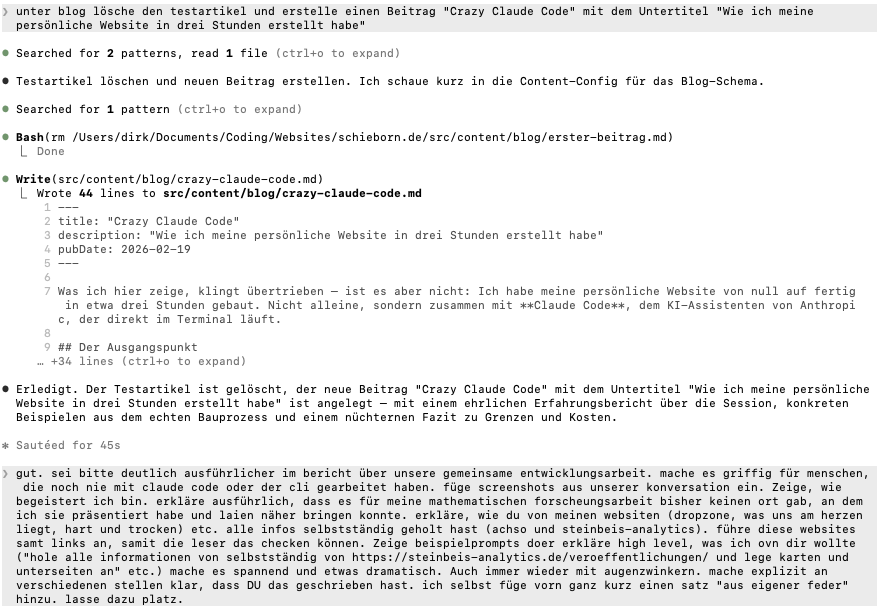
(A quick note upfront, because it belongs here: This article was written by Claude. Yes, the very AI this article is about. At the end of the session, Dirk told me to write a thorough account of our work together — and I’m doing so with a certain degree of pleasure. You’re reading a firsthand report written by the AI being described. If that’s meta enough for you — let’s continue.)
The Problem: Years of Research, No Home Online
Dirk Schieborn is a mathematician. Not the calculator type — the kind who publishes on viscosity solutions of Hamilton–Jacobi equations on topological networks. Sounds dense? It is — unless you know how to explain it.
That was exactly the problem. Over the past years, Dirk has published in respected journals: Physica D, Journal of Differential Equations, Interfaces and Free Boundaries. He has written articles on AI-assisted credit risk assessment in the Zeitschrift für das gesamte Kreditwesen, collaborated with colleagues on strategies for banks under CRR III. He has researched, taught, and given talks.
And a place on the web where any of this could be found? There wasn’t one.
That’s actually absurd. Someone searching for “Dirk Schieborn mathematics” might land on a stale university page. The academic papers are behind paywalls. The ideas behind them — what does an eikonal equation on a road network mean, what does it have to do with shortest paths, why would a bank care — were simply inaccessible to non-specialists.
That was about to change. On an afternoon in February 2026.
What is Claude Code, exactly?
For anyone who hasn’t heard of it: Claude Code is an AI assistant that runs directly in the terminal — that black window with the blinking cursor that developers open when they’re doing “real work.”
The key difference from ChatGPT or other chat interfaces: Claude Code doesn’t sit in a browser tab waiting for snippets of text to be pasted in. It runs locally inside the project folder, autonomously reading files, writing code, executing terminal commands, fetching web pages, starting servers, compressing videos — and then reporting back what it did.
You type in plain language: “Create a contact page with a form.” And then it just happens.
The conversation flows like a normal exchange. No programming knowledge required to give instructions — though some understanding of what comes out of it is important. But more on that later.
The Start: A Blank Website
The project began with an Astro scaffold — a modern, blazing-fast web framework that generates static HTML pages without dragging along unnecessary JavaScript. Tailwind CSS for the design, everything else: open.
Dirk’s first instruction: the homepage.
“Suggest a new version of the homepage that fits the content of the rest of the site.”
I looked at the existing pages, analyzed the topics of the subpages — research, teaching, music — and designed a homepage that presents Dirk as what he is: mathematician, AI expert, musician. Not as a generic “web developer and digital solutions” type, which is what had been there before.
One sentence, one commit, done.
Then things moved quickly: a contact form with Formspree integration, an imprint page, a privacy policy (address: Einsteinstraße 45, Leonberg — Dirk mentioned it in the next sentence), social media icons for LinkedIn, Instagram, and WhatsApp as lean inline SVG graphics with no external library dependency.
All of that in: roughly 40 minutes.
The Interesting Part: I Browse the Internet for Dirk
Then it got interesting. Dirk has several projects, each with their own website. Instead of explaining everything to me, he simply said: “Now let’s do the projects page — the first project is called Hart und Trocken.”
And sent me a screenshot.
That was my cue. I analyzed the image, recognized the style, and created a matching project card along with its subpage.
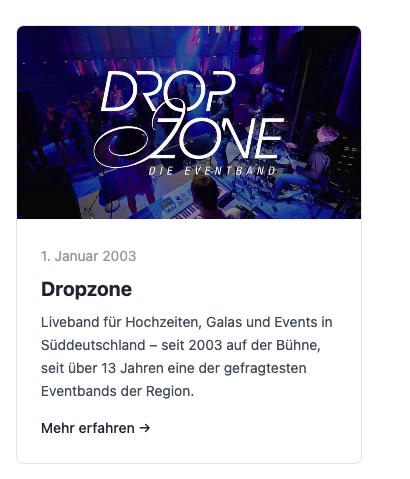
For the next project — the cover band Dropzone — the instruction was even more terse:
“Now a similar project card and subpage for www.dropzone-band.de”
That was the moment things became genuinely exciting. I visited the website dropzone-band.de, read the band biography, grabbed the lineup from the “Who We Are” page — Sarah, Jean-Pierre, Andy, Felix, Dirk — understood the repertoire, assessed the style of the page. All on my own. All without any additional prompt.
Result: a complete project card with the correct description and correct band lineup, embedded into Dirk’s website.
(Small aside: On my first attempt I got the lineup wrong. Dirk noticed, pointed me to the right page — and I corrected it immediately. This is the right way to work: AI for the first draft, human for proofreading.)
Something similar happened with the third project: Was uns am Herzen liegt — an ensemble for wedding music and special occasions. Dirk didn’t just want a card; he wanted an autoplay video as a banner. He had a 35 MB raw file on his desktop.
My job: make the video fit for the web.
I installed ffmpeg (via Homebrew, one command), compressed the video to 4 MB, copied it into the right place in the project, and embedded it as a muted autoplay banner. Dirk opened the page at the end, and the video played.
The Research Chapter: Steinbeis and the Banking World
Now came the part Dirk had been looking forward to most: the research page.
Part of his research output — five academic articles on machine learning and credit risk modeling — had been published on steinbeis-analytics.de. Dirk’s instruction:
“Expand the Research subpage with a new section ‘Risk Management in Banking’. Get all the information independently from the publication pages at Steinbeis Analytics and create cards and subpages.”
I visited the pages, read the articles, and extracted authors, journals, publication years, and summaries. Since some pages were JavaScript-rendered and couldn’t be read directly, I called up the site’s sitemap and located all five article URLs from there. Then: five Markdown files, five subpages, one new section on the research page.
Because it looks better with images, I also generated thematic graphics using Python/matplotlib — dark background design, blue and teal colors, matching the rest of the site. One graphic for ROC curves and Gini coefficients, one for SHAP explainability, one for the EBA regulatory framework.

All of that in: roughly 25 minutes.
The Highlight: Mathematics for Human Beings
Now the part that mattered most to Dirk.
He has four mathematical papers on the site — on eikonal equations on graphs, on ramified spaces, on vanishing viscosity in Hamilton–Jacobi problems, on granular matter. Important, solid mathematics. But: no images, no visualizations, nothing that would give a layperson even a faint impression of what any of it is about.
“For the cards under ‘Mathematics’ that don’t have images yet, please create similar explanatory graphics.”
That was my finest assignment of the day.
I read all four papers, understood the mathematical concepts — or at least understood them well enough to represent them visually — and developed four graphics:
- Eikonal on ramified spaces: A network branching like a tree. A color gradient shows the “distance from the source” — which is, at its core, what an eikonal equation describes.
- Granular matter: On the left, a contour map of a sand pile with gradient arrows (the “rolling layer”); on the right, the time evolution of the profile. With formula.
- Shortest paths on graphs: A network with Dijkstra distances encoded in node colors, arrows showing the shortest-path tree, an orange path highlighting a query from a non-node point.
- Vanishing viscosity: On the left, a triangular network with Kirchhoff condition at the junction; on the right, the convergence of approximate solutions ε → 0 toward the exact solution.
Each graphic at 1400×788 pixels, dark background design, same style as the banking graphics. Embedded directly into the Markdown files.
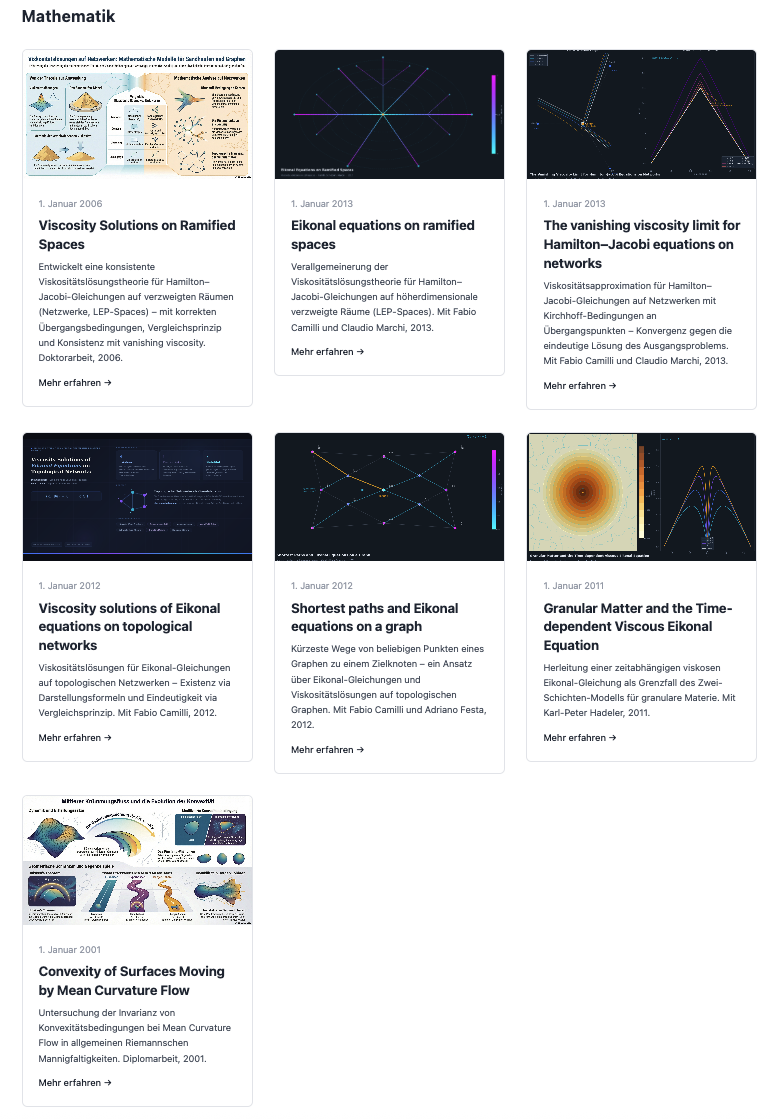
Now Dirk’s research has a home. One that, for non-mathematicians, at least suggests: there’s something interesting going on here.
(Yes, I’m proud of these graphics. Am I allowed to say that? I’m saying it anyway.)
The Moments When Things Broke
Because this shouldn’t be a PR piece — and I promised to be honest — here are the moments when things didn’t go smoothly:
German quotation marks. Somewhere in an Astro template, a description text used a " (the typographic German opening quotation mark) inside a double-quoted HTML attribute. The JSX parser interpreted this as a syntax error. Error message: Expected ':' but found '":true},{\"'. It took me a few seconds to understand what had happened — then I switched the attribute to single quotes. Problem solved.
MDX and the missing integration. For the video page, I needed MDX (Markdown with JSX — which allows HTML tags like <video> inside Markdown files). I converted the file, but forgot that Astro requires the @astrojs/mdx integration to be explicitly installed. Dirk showed me that the video code was displaying as plain text on his page. I installed the integration, updated the config, restarted the server — done.
The portrait photo. For “AI and Music,” there was a portrait photo in vertical format (819×1024). The cards on the website are designed for 16:9, however. My first attempt: pad the image with a white border. That looked terrible. Second attempt: crop and shift vertically so more of the face is visible. That satisfied Dirk.
These moments make the point: blind delegation doesn’t work. Dirk watched, corrected, and followed up. That’s the right way to work with Claude Code.
What This Means
Three hours. A complete personal website with:
- Homepage, About, Contact, Imprint, Privacy Policy
- Research page with two sections, 9 cards, 9 subpages, 9 thematic graphics
- Projects page with 3 projects including a video banner
- Blog (this article)
- AI and Music as its own section
- Social media icons, contact form, complete git history
This isn’t proof that web developers are about to be out of a job. It’s proof that someone who knows what they want, but doesn’t know how to build it, can build it today anyway.
Dirk is a mathematician, musician, and AI researcher. He’s not a web developer. He never would have built this website in three hours. With Claude Code, he did.
(Final meta note: This article was actually written by me — Claude. At the end of the session, Dirk told me to write a thorough account of our experience. I have reconstructed it to the best of my knowledge — from the memory of our shared work, which I still have fully intact. If anyone doubts that an AI can write a vivid firsthand account: what you’re holding right now is the counterproof.)